Don’t leave your Wharton MBA application to chance!
Work with the best in the business so you too can become an MBA success story!
Request Consultation
About The Wharton School Of The University Of Pennsylvania
Wharton, the world’s oldest business school, is known for its rigorous academic programs, pioneering research, and its focus on developing innovative and globally minded business leaders. Located in Philadelphia, Pennsylvania, Wharton offers a highly selective two-year MBA program, four interdisciplinary graduate programs (including the one of a kind MBA/MA Lauder Joint Degree in International Studies Program and MBA in Healthcare Management Major), a top-ranked undergraduate program, and a range of executive education and doctoral programs.
Wharton is particularly renowned for its emphasis on analytics, finance, and leadership development. Wharton’s location in the heart of the Northeast business corridor also gives students access to an extensive network of companies, venture capital firms, and nonprofit organizations.
The school provides unparalleled access to resources such as the McNulty Leadership Program, which helps students refine their leadership capabilities through experiential learning and coaching. Additionally, Wharton’s robust global network, extensive alumni base, and access to initiatives like the Wharton Social Impact Initiative and Venture Lab empower students to drive meaningful change across industries and around the world. This dynamic environment ensures that Wharton graduates are equipped to lead in an ever-evolving global business landscape.

Wharton MBA Core Values
Understanding an MBA program’s core values is crucial for applicants because these principles shape the learning environment and overall student experience. The Wharton Way is the strategic framework that guides the school’s commitment to advancing business education and societal progress. It focuses on three key areas:
Elevation of its Research: Wharton is dedicated to producing cutting-edge research that addresses the world’s most pressing business and societal challenges. Although research is often not student-facing, it has long-term implications for the academic experience and value of the MBA degree. By fostering an environment that attracts top scholars and thought leaders, Wharton ensures that its insights drive innovation and actionable solutions. Wharton’s research not only influences academic discourse but also informs policy and business practices globally. This focus on impactful scholarship underscores its role as a leader in shaping the future of business.
Pedagogical Innovation: Wharton constantly reimagines its approach to education, integrating the latest technology and methodologies to enhance the learning experience. The school prioritizes real-world application through experiential learning, simulations, and interdisciplinary courses. By staying ahead of business trends, Wharton equips students with the tools and knowledge to solve tomorrow’s challenges. This commitment to innovation ensures that graduates are agile, forward-thinking leaders prepared to thrive in dynamic environments.
Collaboration Across Disciplines and Divides: Lastly, Wharton fosters partnerships that bridge disciplines, industries, and global communities. By encouraging collaboration between scholars, practitioners, and policymakers, the school develops solutions that address complex, multifaceted issues. This inclusive approach ensures that diverse perspectives are valued and leveraged for more equitable and impactful outcomes. Through interdisciplinary initiatives, Wharton builds connections that amplify its influence and drive progress on a global scale.
Wharton MBA Class of 2027 Profile
The Wharton MBA Academic Experience
The academic experience in the Wharton MBA program is defined by its rigorous curriculum, flexibility, and emphasis on real-world application. Students begin their journey with a comprehensive core curriculum designed to build foundational knowledge in key areas such as finance, leadership, marketing, and operations. These core courses provide a strong analytical and strategic framework that equips students to tackle complex business challenges. Throughout the core curriculum, students are divided into 4 clusters. Each cluster is then divided into three cohorts (70 students each) that each complete the courses together. Within that cohort, students are assigned to a learning team (5-6 students) who will work together on all group projects and assignments.
Flexibility is a hallmark of the Wharton MBA, with over 200 elective courses available for students to customize their learning experience. These electives span 18 majors, including entrepreneurship, healthcare management, and business analytics, allowing students to tailor their studies to their career goals and interests. Students can also cross-register for courses in other schools within the University of Pennsylvania, further broadening their educational opportunities. This multidisciplinary approach encourages creative problem-solving and fosters a comprehensive understanding of complex business challenges.
Notably, courses like Leadership Ventures – hands-on leadership experiences that take students on international and domestic trips to work with teams on real-world projects – are integral to Wharton’s commitment to developing practical leadership skills. Additionally, Wharton offers opportunities for students to participate in Global Modular Courses, which combine business theory with experiential learning, allowing students to explore global business environments and cultural differences.
A key aspect of the Wharton academic experience is its emphasis on experiential learning. Programs such as the Wharton Global Modular Courses and Leadership Ventures provide students with opportunities to apply classroom concepts to real-world scenarios. These hands-on experiences help students develop practical skills and foster a deep understanding of how to navigate complex business environments. For example, the Global Modular Courses offer intensive, short-term learning experiences in international settings, giving students first-hand exposure to global business challenges.
Wharton also emphasizes leadership development as a cornerstone of its academic approach. The McNulty Leadership Program, including courses like Foundations of Teamwork and Leadership and the Executive Coaching and Feedback Program, helps students refine their leadership capabilities. These programs combine self-assessment, peer feedback, and expert coaching to help students become more self-aware and effective leaders. Leadership development is woven into the entire MBA experience, ensuring students graduate with the skills and confidence to lead in any industry or role.
Finally, the Wharton MBA fosters a collaborative and intellectually stimulating atmosphere. The school encourages students to challenge assumptions and engage in thoughtful discussions. This culture of collaboration is reinforced by Wharton’s team-based learning approach, where students tackle projects and case studies in groups, mirroring real-world business dynamics. Similar to other top MBA programs, Wharton students adopt a grade non-disclosure policy, which emphasizes collaboration over competition.

What Is Wharton Really Looking For?
While the Wharton MBA class profile offers insight into the academic background and characteristics of incoming students, it does not fully reveal the traits that the admissions committee is looking for. The school’s evaluation criteria provide more clarity, but applicants may find it challenging to assess how their individual profile fits these criteria.
However, through our experience, we have found that successful Wharton admits, regardless of their backgrounds, typically share these three qualities:
1. Leadership Potential
Wharton seeks candidates who have demonstrated leadership abilities or potential in their academic, professional, and/or personal lives. This includes showing initiative, taking ownership of projects, motivating others, and having the ability to create impact in team settings. Leadership is not limited to formal managerial experience but also includes the ability to inspire others, innovate, and lead by example.
2. Academic Excellence + Intellectual Curiosity
Strong academic performance and intellectual curiosity are crucial. Applicants should show they have the capacity to succeed in Wharton’s rigorous academic environment. The admissions team values individuals who are not only strong in quantitative and analytical skills but who also show a genuine interest in learning and broadening their knowledge. This includes curiosity about the business world and a desire to deepen expertise in areas beyond the classroom.
3. Collaborative Mindset
Wharton places a high value on collaboration and teamwork, as evidenced by the academic experience and even the unique admissions interview format (a group interview called a “Team-Based Discussion”). Applicants should demonstrate the ability to work effectively in diverse teams, respect differing perspectives, and contribute to collective goals. The admissions team looks for candidates who can thrive in a highly collaborative atmosphere, contributing to both their peers’ success and the broader community.
Chat with an expert about your fit for Wharton's MBA Program
Sign Up for a Free Consultation
The Wharton MBA Application Process
Like all top MBA programs, Wharton’s admissions process is holistic, considering not only quantitative measures such as test scores and GPAs but also the entirety of an applicant’s background. Below are the key dates and requirements for the 2025-2026 Wharton MBA application.
Deadlines:
- Round 1: September 3, 2025 at 5:00 PM ET
- Round 2: January 6, 2026 at 5:00 PM ET
- Round 3: April 1, 2026 at 5:00 PM ET
- Deferred Admissions Round: April 22, 2026 at 5:00 PM ET
Application Requirements:
- Completed Application Form: Applicants must fill out the online application form on Wharton’s admissions website.
- Transcripts: Official academic transcripts from all post-secondary institutions attended must be submitted.
- GMAT or GRE Scores: Applicants must submit either GMAT or GRE scores.
- Resume: A current resume highlighting functional job skills, breadth and depth of experience, leadership and management skills, and your potential for growth is required.
- Essays: Applicants must submit several required essays, with an optional question for additional context. The essay prompts are as follows:
Essay 1: Two Short-Form Questions
What is your immediate post-MBA professional goal? (50 words)
What are your career goals for the first three to five years after completing your MBA, and how will those build towards your long-term professional goals? (150 words)
Essay 2: Long-Form Essay
Taking into consideration your background – personal, professional, and/or academic – how do you plan to add meaningful value to the Wharton community? (350 words)
Please note that joint degrees and interdisciplinary programs have additional essay requirements. Please refer to the Wharton admissions website for further information.
- Optional Essay: Please use this space to share any additional information about yourself that cannot be found elsewhere in your application and that you would like to share with the Admissions Committee. This space can also be used to address any extenuating circumstances (e.g., unexplained gaps in work experience, choice of recommenders, inconsistent or questionable academic performance, areas of weakness, etc.) that you would like the Admissions Committee to consider. (500 words)
- Letter of Recommendation: One letter of recommendation is required, preferably from a current or former supervisor who can speak to the applicant’s qualifications, work ethic, and character.
- Interview: By invitation only. Candidates who have been invited to interview will participate in the Wharton MBA Team-Based Discussion (TBD).
- English Language Proficiency: Non-native English speakers may need to provide proof of English proficiency through tests such as TOEFL or IELTS, unless they have completed a degree in an English-speaking institution.
- Application Fee: A non-refundable application fee is required, but applicants may request a fee waiver if they meet certain criteria.

Wharton MBA Essay Tips
For Wharton’s two Short-Form Questions, the key is clarity and intention. The first response should be a concise statement of your immediate post-MBA goal – think job title, function, and industry – without storytelling or extra context. Wharton wants to see that you’ve done your homework and have a realistic plan for what you’ll pursue right after graduation. The second response invites a broader view of your professional path. Here, outline where you hope to be three to five years post-MBA and how that direction connects to your longer-term vision. Focus on logical progression, self-awareness, and the motivations behind your goals so the admissions committee can understand both where you’re headed and why.
In the Long-Form Essay, by asking “How do you plan to make specific, meaningful contributions to the Wharton community?”, the admissions committee is signaling that it seeks applicants who will not only benefit from the program but will actively enhance the experience for their peers and strengthen the community as a whole. As such, think about what unique experiences or perspectives you bring to the table, and how you plan to share those with others in the MBA setting. Be specific in describing how you intend to get involved, whether through student organizations, social impact initiatives, and/or academic discussions.
The Optional Essay is purely optional and we recommend only answering it if you have an obvious weakness or gap in your profile that needs to be addressed. Topics such as a low GPA or test score, resume gap, or choice of recommender would be appropriate to address here. Otherwise, it is perfectly OK to leave it blank.
For a detailed analysis of Wharton’s essay prompts, please see Wharton MBA Essay Tips (2025-2026).
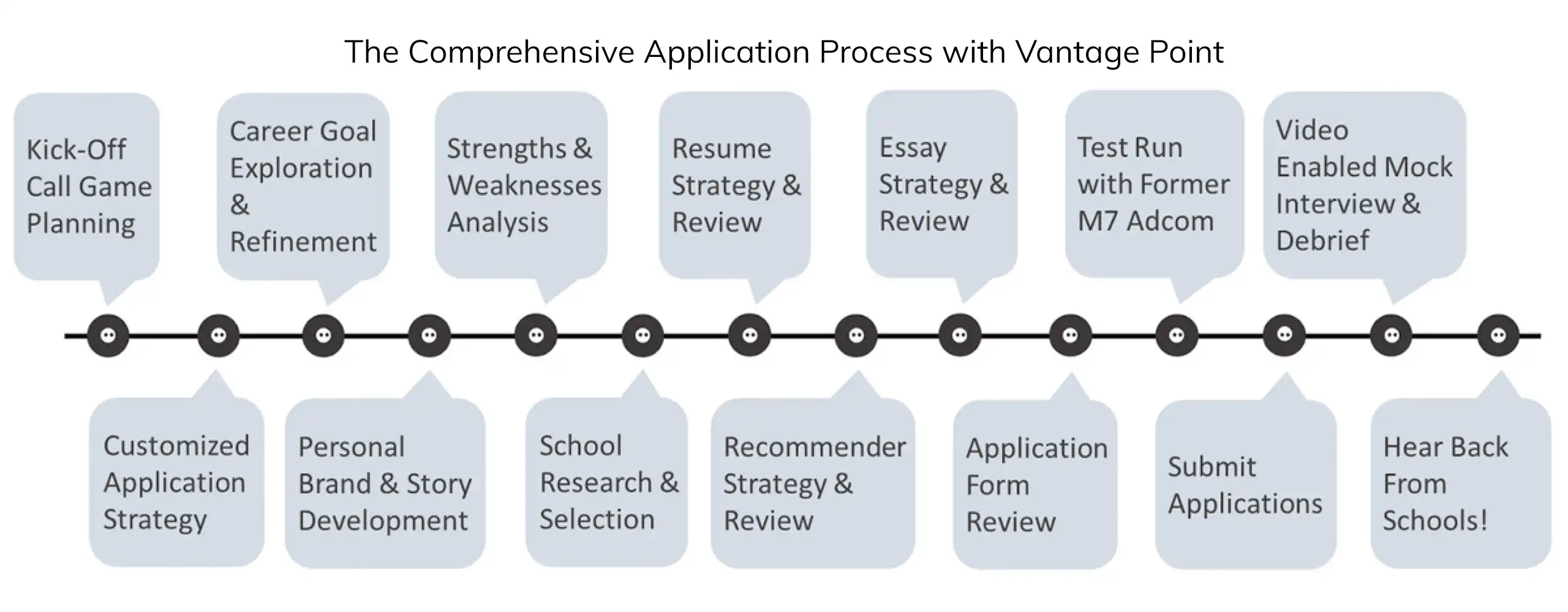
If Wharton is on your list of dream schools, your next step is to request a free consultation with our team at Vantage Point MBA. We’ll share candid advice on your profile, answer your questions, and walk you through our services & pricing so you understand exactly how we can help you get accepted.
Frequently Asked Questions (FAQs)
What is the minimum GMAT score for Stanford GSB?
What is the minimum GMAT score for Wharton?
Does Stanford GSB prefer the GRE or the GMAT?
Does Wharton prefer the GRE or GMAT?
What is the cost of attending Stanford GSB?
What is the cost of attending Wharton?
Does Stanford GSB offer scholarships or financial aid?
Does Wharton offer scholarships or financial aid?
Can I reapply if I am not admitted to the Stanford MBA program?
Can I reapply if I am not admitted to the Wharton MBA program?
Don’t leave your Wharton MBA application to chance!
Work with the best in the business so you too can become an MBA success story!
Request Consultation