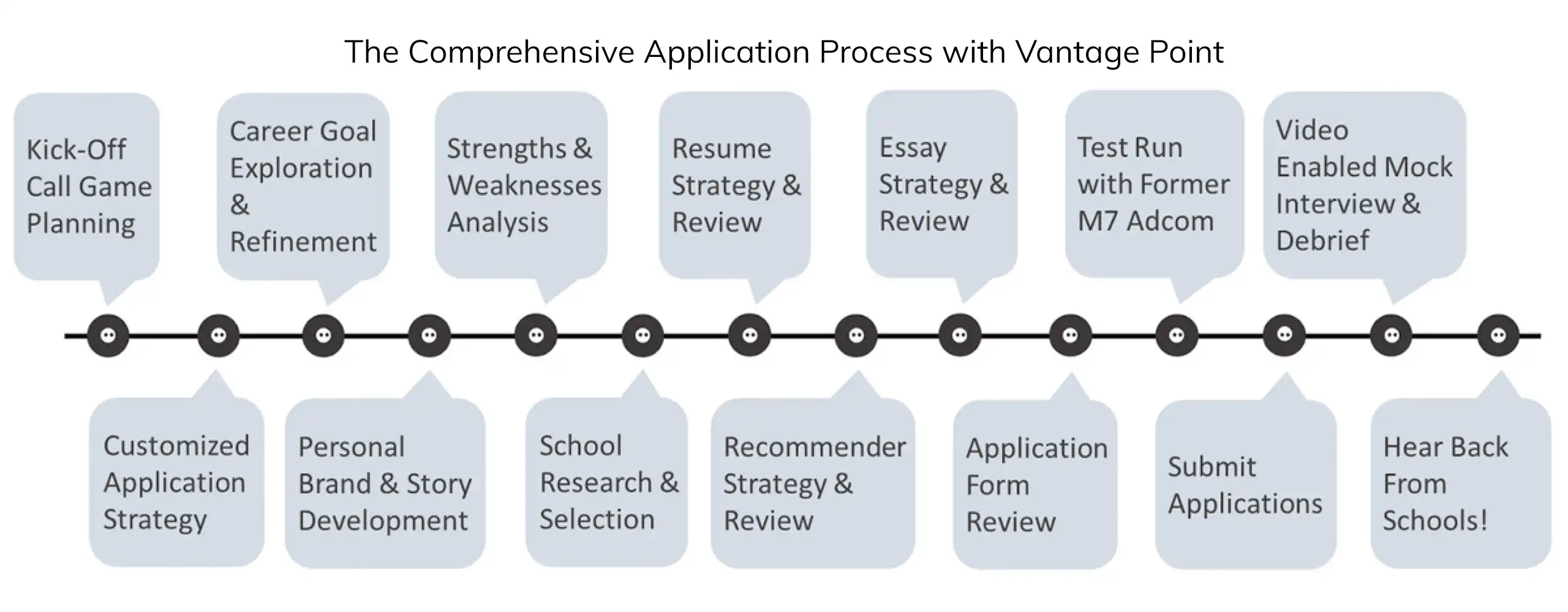
Don’t leave your Columbia MBA application to chance!
Work with the best in the business so you too can become an MBA success story!
Request Consultation
About Columbia Business School (CBS)
New York City is the ultimate business classroom. At Columbia Business School, students gain a real-world edge. CBS offers a highly selective two-year MBA program, along with Dual Degree programs (such as MBA/JD), Executive MBAs (EMBA), Master of Science (MS) programs, and PhD options, preparing graduates to lead in the global marketplace.
One of the defining features of Columbia Business School is its strong connection to the world’s financial capital, providing students with unparalleled access to alumni, business leaders, and career opportunities across various sectors. Specifically, the school’s proximity to Wall Street and its vast network of alumni in top leadership positions offer invaluable real-world insights and professional connections.
Columbia’s entrepreneurial spirit is fostered through initiatives like the Lang Center for Entrepreneurship, which provides students with resources, mentorship, and opportunities to launch new ventures. The school’s focus on blending theory with practice, coupled with its emphasis on global leadership, equips students with the tools to tackle complex business challenges and lead impactful change throughout their careers.
Additionally, Columbia provides distinctive academic and career pathways, including luxury goods and fashion, real estate, family business, and social impact, not found at many other M7 programs.
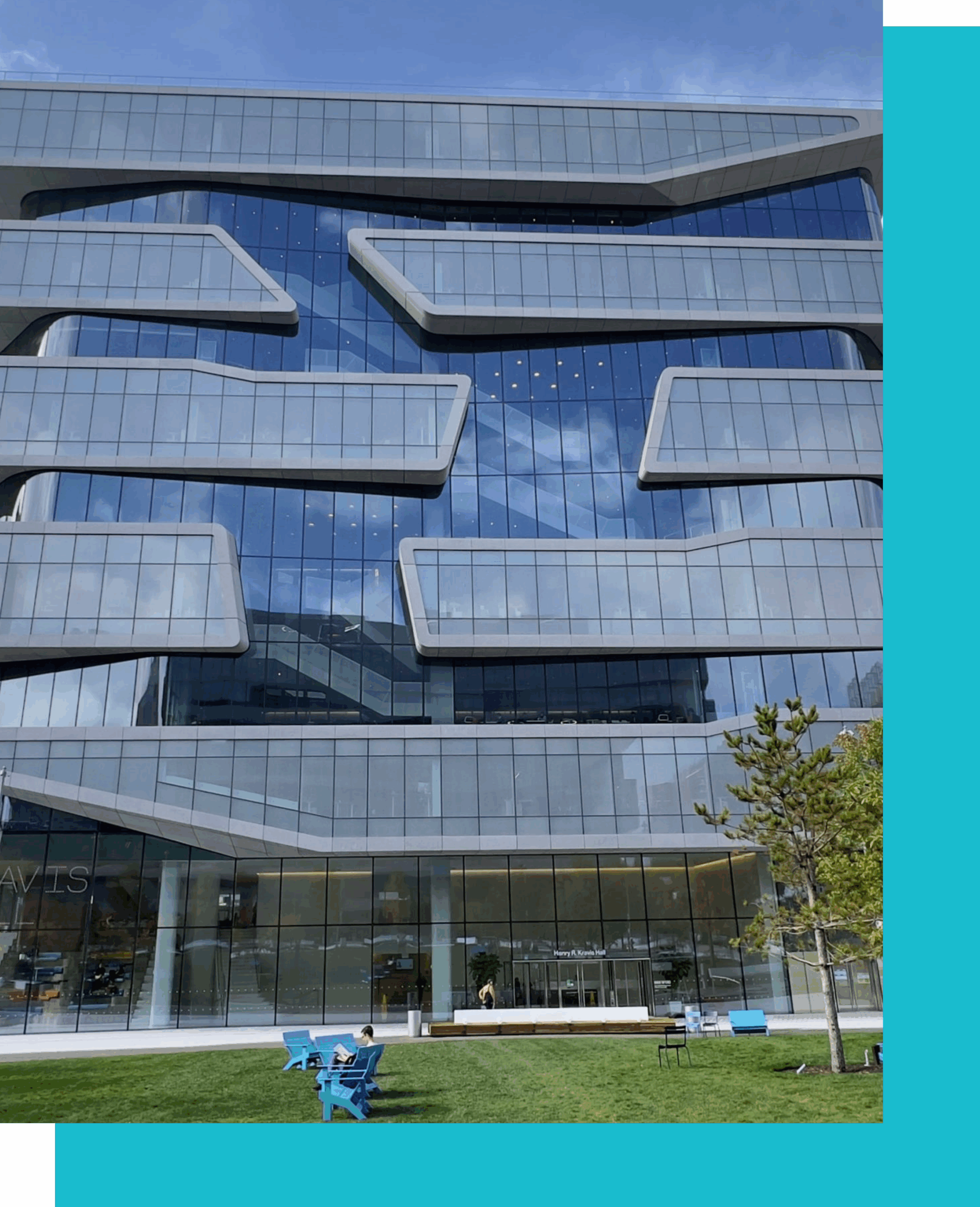
Columbia Business School Core Values
What sets Columbia Business School apart? Besides being the only M7 (i.e., top business school) in New York City, Columbia describes itself as being “committed to educating and developing leaders and builders of enterprises who create value for their stakeholders and society at large.” Overall, CBS can be celebrated for 3 core values.
Connecting Theory to Practice:
Columbia prides itself on being “at the very center of business” in New York City, and takes that real-world access to heart through practical application of academic learnings. CBS offers aligned programming such as the Executives in Residence Program, where C-level executives across a range of industries are paired one-on-one with students to help bridge theory and practice. The resources to connect to the real business world are abundant, from in-semester internships to afternoon coffee chats to on-campus conferences, and even 100+ adjunct faculty practitioners who hail from leading corporations.
Meeting an Ever-Changing World:
CBS stands at the forefront of change and innovation, shaping the future of business through a dynamic, ever-evolving curriculum. Grounded in NYC’s vibrant business ecosystem, the school connects students to top industry leaders, faculty research, and emerging trends across sectors like digital transformation, finance, sustainability, and climate change. For example, Columbia has invested in addressing global environmental challenges through programs like the Climate Change and Business Program and the annual Climate Science & Investment Conference. From advancing renewable energy research to evaluating climate pledges, Columbia connects cutting-edge research with actionable insights for a sustainable future.
Inclusivity, Respect, & Community:
CBS is well known for its commitment to inclusivity, respect, and community, as evidenced by its diverse alumni population with 123 countries represented. Columbia has respect and community built into its academic structure through the Cluster and Learning Team systems, which connect diverse classmates in intimate settings. The school further demonstrates its commitment to inclusivity through the Phillips Pathway for Inclusive Leadership (PPIL) program. The PPIL is a program of elective classes designed to provide students with the skills needed to develop as inclusive leaders, celebrating 5 core leadership skills: Exploring Identity and Perspective Taking; Understanding Bias and Prejudice; Engaging in Dialogue; Addressing Inequities; and Creating Inclusive Environments. Overall, just like the diverse city it lives in, the Columbia community is one that celebrates respect and inclusivity of each individual.
Columbia Business School MBA Class of 2027 Profile
The Columbia Business School MBA Academic Experience
Columbia’s large class size of almost 1,000 students, which allows for excellent opportunities to connect with a multitude of classmates across cultures and industries, is balanced with the intimacy of its first-year academic structure. Students begin their academic experience in the Core Curriculum. Composed of 2 full-time courses and 8 half-term courses, the Core is crafted to provide comprehensive expertise in a variety of academic disciplines and practical functional areas essential for every business leader. Classes are offered in areas such as accounting, marketing, finance, leadership, and operations.
The Core Curriculum is experienced within the Cluster system, with each January and August class divided into sub-groups of approximately 70 students. The Cluster is meant to provide a more intimate, close-knit framework for navigating the MBA experience. Additionally, each Cluster is further split into Learning Teams of approximately 5 students each. The Learning Teams are purposefully organized to be diverse and become your teammates for all Core Curriculum group projects. All Core classes are taken within a student’s Cluster, and the Cluster remains intact for the entirety of the 2 year MBA experience.
Upon entering the second semester, students will typically have one last Core curriculum class to complete, and can begin to enjoy the variety and flexibility of CBS electives. Fields covered in the electives are extensive, and include entrepreneurship, sustainability, family business, and value investing. This breadth of options, coupled with the ability to take courses at Columbia’s other schools, such as the Columbia Law School or the School of International and Public Affairs, allows students to integrate knowledge from diverse disciplines, enriching their problem-solving skills. Additionally, students have the option to complete a semester abroad with many partner institutions and countries, such as London Business School (LBS).
What truly differentiates Columbia’s MBA experience is its commitment to creating an environment that boasts “theory meets practice” and “access” within the world’s center of business (New York City). Through resources such as the Global Immersion Program, Entrepreneurs in Residence, or the real world professionals teaching classes, Columbia offers opportunities for practical application of learnings.
Lastly, the grade non-disclosure policy, which ensures that grades are not shared with employers, also helps reinforce a culture of collaboration over competition, further enhancing the focus on personal and professional growth.

What Is Columbia Business School (CBS) Really Looking For?
The Columbia Business School admissions team takes a holistic approach when evaluating applicants, looking beyond just test scores and GPA to find candidates who demonstrate the potential to thrive in a collaborative and dynamic environment. While the class profile provides some insight into the types of students CBS admits, there are certain qualities that the admissions committee specifically seeks in every applicant:
1. Professional Promise
Columbia wants to very clearly understand your goals (including short, mid, and long-term), and what your specific plan is to achieve them. The admissions committee wants to see that you have thoughtfully considered how your existing experiences, skills, and networks can be leveraged and combined with an MBA to achieve your goals. Additionally, Columbia is looking to ascertain how your goals align to the opportunities and resources at CBS. Are your goals ambitious, yet realistic? Furthermore, Columbia will look for professional promise in your application through indicators such as a track record of success (e.g. promotions, increased responsibilities, awards, etc.), professional accomplishments (e.g. hitting sales targets, leadership stories, etc.), and the stories in your recommendation letter.
2. Principled Leadership
CBS is looking to create leaders who are team players, collaborative, and inclusive. Columbia clearly honors teamwork through creating opportunities for collaboration via the Cluster system and Learning Teams, where students are expected to contribute thoughtfully and work effectively in diverse group settings. Overall, you can show leadership promise in your application through areas such as coaching, mentoring, teaching, recruiting, etc. Principled leadership can be demonstrated through your morals, ethics, and decision making showcased in your stories and essays.
3. Creating Your Own Experience
Columbia wants to understand why CBS is the right program for the applicant, and how you will co-create your experience with the school (especially as evidenced by Essay Three). Consider how Columbia is differentiated from other M7 programs and why those unique qualities are relevant or helpful to you. Overall, show the admissions committee how CBS is a two-way fit.
4. Community Contribution
The admissions committee wants to see a clear track record of community contribution and engagement. They are seeking to understand if you will be a positive and active part of the school’s community, enriching it as a student and one day as an alumnus. It is helpful to show community contribution through a variety of extracurricular activities and hobbies. For example, during college, this can include school clubs and related activities. Post-college, this can include professional engagement in activities outside of your immediate job, such as ERGs (Employee Resource Groups) or company recruiting efforts. Outside of work, engagement can include hobbies or other activities such as sports, volunteering, a book club, and more.
Chat with an expert about your fit for Columbia Business School's MBA Program
Sign Up for a Free Consultation
The Columbia Business School MBA Application Process
Columbia Business School students may enroll in either August or January. The two paths, each comprising four terms, merge in the fall of the second year to complete electives as a single class.
The paths are identical in terms of competitiveness of admissions, academic rigor, and student resources; but only students who enter in August will be able to complete a summer internship. January-entry (J-Term) students, having completed their first-term courses in the spring, will instead complete their second-term course work over the summer.
Deadlines:
January 2026 Entry Application Deadlines
Round 1: June 17, 2025
Round 2: August 14, 2025
August 2026 Entry Application Deadlines
Round 1: September 3, 2025
Round 2: January 6, 2026
Round 3: March 26, 2026
Application Requirements:
Please note that re-applicants or dual-degree program applicants may have different or additional requirements.
1. Completed Application Form: Applicants must submit the online application form on the Columbia Business School website.
2. Transcripts: A bachelor’s degree or its equivalent from an accredited institution is required for admission to Columbia Business School.
3. GMAT or GRE Scores: Applicants must submit scores from either the Graduate Management Admission Test (GMAT), Executive Assessment (EA), or the Graduate Record Examination (GRE). There is no preference for one over the other. CBS considers scores to be valid for five years after your test date.
4. Resume: A current resume is required, outlining your work experience, education, and any other achievements relevant to your application.
5. Essays: Columbia Business School requires multiple essays and short-answer questions, with one additional optional essay question for applicants to provide any further context.
What is your immediate post-MBA professional goal? (50 characters maximum)
[January Entry Only] Why do you prefer the January-entry term? (50 characters maximum)
[August Entry Only] How do you plan to spend the summer after the first year of the MBA? If in an internship, please include target industry(ies) and/or function(s). If you plan to work on your own venture, please indicate a focus of business. (50 characters maximum)
Through your resume and recommendation, we have a clear sense of your professional path to date. What are your career goals over the next three to five years and what is your long-term dream job? (500 words)
Please share a specific example of how you made a team more collaborative, more inclusive or fostered a greater sense of community within an organization. (250 words)
We believe Columbia Business School is a special place with a collaborative learning environment in which students feel a sense of belonging, agency, and partnership–academically, culturally, and professionally. How would you co-create your optimal MBA experience at CBS? Please be specific. (250 words)
Optional Essay: If you wish to provide further information or additional context around your application to the Admissions Committee, please upload a brief explanation of any areas of concern in your academic record or personal history. This does not need to be a formal essay. You may submit bullet points. (Maximum 500 Words)
7. Letters of Recommendation: One letter of recommendation is required. If you have been working full-time for at least 6 months, it is recommended that one letter be from a direct supervisor.
8. Interview: Selected applicants are invited for an interview. Interviews are by invitation only and are an important part of the evaluation process.
9. Application Fee: A non-refundable application fee of $250 is required. Fee waivers are available to full-time students, active duty US military personnel, eligible displaced persons (view this website for displaced eligibility criteria), and members of the Peace Corps or Teach For All network partners who are currently in service.
Columbia Business School MBA Essay Tips
For the Short-Answer questions, remember to be specific and straight-forward due to the limited character count. You must also ensure that the answers align to your career goals outlined in Essay One. Writing in phrases is acceptable.
For Essay One, it’s crucial to highlight not just your goals but the why behind them, often rooted in past experiences. Share specific, targeted stories that explain your passion for your chosen path, such as entrepreneurial ventures or personal insights into your industry. After providing this context, focus on your future aspirations, showing how you’ll grow and achieve success post-MBA while dreaming big about your long-term vision.
Essay Two doesn’t require grand-scale impact; even smaller stories where you demonstrated inclusive leadership can be powerful. Use most of the word count to describe your actions in detail, making the reader feel like they were there, and end by showing the impact of your efforts on others.
For Essay Three, emphasize action by illustrating how you’ll co-create your MBA experience. This involves personal and specific connections to CBS, such as unique classes, clubs, or peer experiences that align with your goals. Incorporate genuine insights from student or alumni interactions, and help the reader picture you as an engaged member of the CBS community contributing to its collaborative culture.
The Optional Question is truly optional and should only be used to provide further context or explain any aspects of your candidacy that may need clarification.
If CBS is on your list of dream schools, your next step is to request a free consultation with our team at Vantage Point MBA. We’ll share candid advice on your profile, answer your questions, and walk you through our services & pricing so you understand exactly how we can help you get accepted.
Frequently Asked Questions (FAQs)
What is the minimum GMAT score for Stanford GSB?
What is the minimum GMAT score for Columbia Business School?
Does Stanford GSB prefer the GRE or the GMAT?
Does Columbia Business School prefer the GRE or the GMAT?
What is the cost of attending Stanford GSB?
What is the cost of attending Columbia Business School?
Does Stanford GSB offer scholarships or financial aid?
Does Columbia Business School offer scholarships or financial aid?
Can I reapply if I am not admitted to the Stanford MBA program?
Should I apply to the January or August entry full-time program?
Can I reapply if I am not admitted to the Stanford MBA program?
Can I reapply if I am not admitted to the Columbia MBA program?
Don’t leave your Columbia MBA application to chance!
Work with the best in the business so you too can become an MBA success story!
Request Consultation