Is a 2.5 GPA a Non-Starter for MBA Admission? How To Overcome a Low GPA
Many applicants worry that a low GPA will hurt their chances of admission.
You may have chosen a difficult major, overcommitted to activities, or struggled to manage your time. The good news is that you can often mitigate a low GPA in your MBA application.
For most applicants, college happened years ago. Since then, you have likely built your career, earned promotions, and taken on leadership roles. These achievements show leadership and professional growth. However, they do not prove that you can handle a rigorous academic environment.
MBA programs often highlight internships, networking, and experiential learning. However, an MBA remains a rigorous academic degree with demanding coursework. The coursework demands that you can study, apply theories to cases, write essays, and pass tests.
Admissions committees assess your academic ability using your GMAT score and GPA. What can you do if your GPA falls below your target schools’ averages? The key is to focus on two things: 1) explaining and 2) overcoming.
Explaining a Low GPA
Note that I did not use the word “justify”. Explaining is not making excuses; explaining is simply stating what ‘it’ was and why ‘it’s’ better now (whatever ‘it’ was).
Be honest and direct. If your GPA suffered early in college due to poor time management or overcommitment, say so. Then explain how you improved those skills. In fact, it shows a great deal of maturity and self-reflection.
Then show how you improved. For example, highlight strong academic performance or success managing complex projects at work. Be brief but specific – you don’t want them to assume that you are being vague because the real reason for your low GPA is that you just partied too much.
Include this explanation in the optional essay section. This is where you directly point out that certain areas of weakness, including a low GPA, are not reflective of the strength of your candidacy.
Overcoming a Low GPA
In addition to explaining why you had a low GPA in undergrad, you also want to use the optional essay to share what you’ve done to demonstrate your academic ability.
The best proof is strong performance in a post-graduate course. Many applicants take online or in-person classes to strengthen their profile. These options fit a wide range of schedules.
On the higher end of commitment level are live classes through a local community college or university continuing education department. These work well for people who learn best in a group setting and want to be held to a more concrete schedule.
Self-directed online courses offer more flexibility and may appeal to those who travel for work (in a non-COVID world) or have less control over their day-to-day schedule. Online classes also range in commitment level and costs. On the lower end of the commitment and time spectrum, MBAMath.com costs $149 for modules covering topics like statistics, accounting and finance that can be completed in 20-40 hours. On the higher end of commitment and time is Harvard Online’s CORe program, which costs $2,250 and is estimated to take approximately 150 hours to complete. Of note, many estimate that a rather large percentage of HBS admits have taken CORe (this is anecdotal, of course). Other popular options include Wharton’s Coursera courses (target the graded versions) and UC Berkeley’s Extension.
Focus on foundational quantitative subjects you didn’t study in college (or performed poorly in) like accounting, statistics and/or calculus. By doing well in one of these courses, you can ask the admissions committee to look at your additional coursework grades as an indication of your ability to succeed in the classroom instead of your undergrad coursework. Typically, this demonstration, paired with a strong GMAT score, will help an admissions director to feel more comfortable with a low GPA.
Aside from increasing your chances, taking additional coursework shows your commitment and willingness to prepare for the MBA experience, which signals that you are ready to get as much value out of the program as humanly possible (and the admissions committee likes that!).
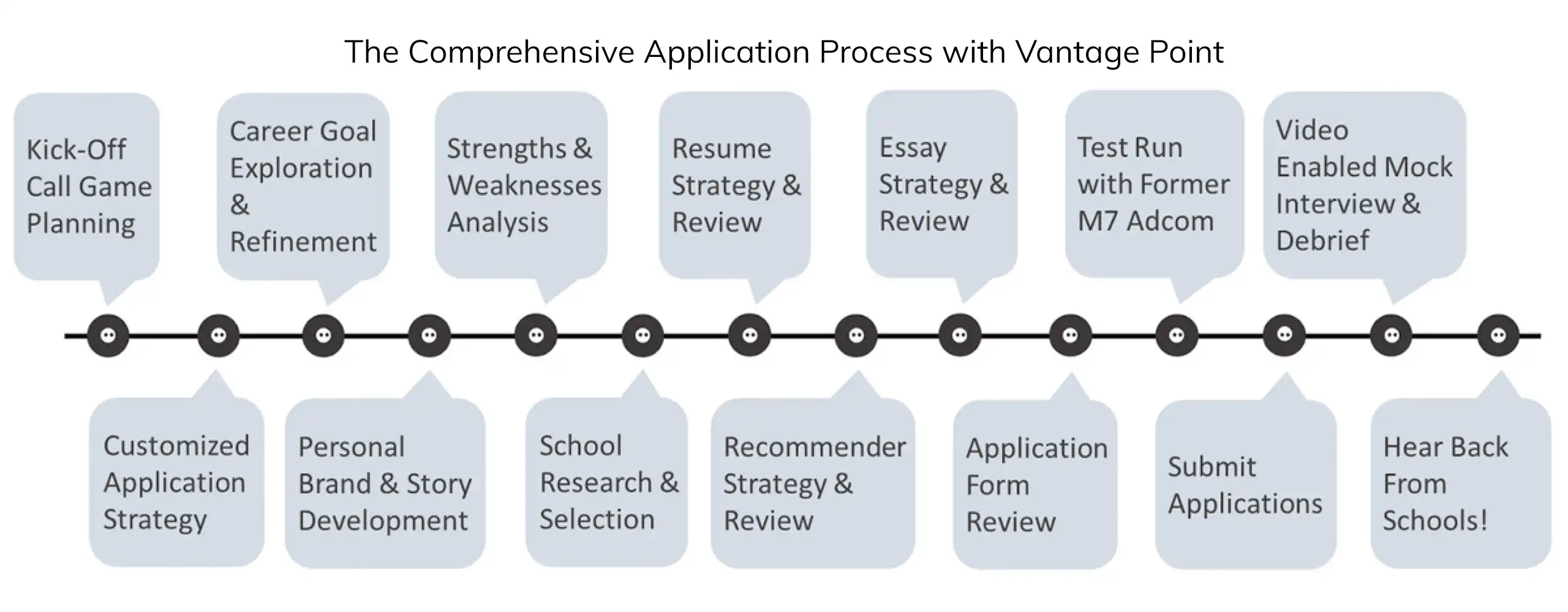
Interested in a personalized assessment of your profile or help with your applications? Reach out to schedule an initial consultation.

After embarking on my own MBA journey, I founded Vantage Point MBA Admissions Consulting to help aspiring business school students get accepted to the top MBA programs in the U.S. and Europe. As President, I currently lead a team of over 25 superstar consultants to give our clients an unmatched experience, with a focus on white glove, personalized collaboration and mentorship.